
Activities Report / InformationREPORT & INFORMATION
2026.11.02
Medical and disease
information
- #Lysosomal storage diseases
- #Mucopolysaccharidosis type I
- #Hurler syndrome
- #Scheie syndrome
Mucopolysaccharidosis type I
- What are Mucopolysaccharidoses?
-
Mucopolysaccharidoses (MPS) are a group of disorders collectively known as lysosomal storage diseases. When an individual is born with a deficiency or reduced activity of an enzyme that breaks down mucopolysaccharides, these substances gradually accumulate in the body, leading to the development of MPS.
There are more than 10 different enzymes responsible for breaking down mucopolysaccharides. The specific type of MPS a person has depends on which of these enzymes is lacking or not working properly.
Related Article: Basic Knowledge of Mucopolysaccharidoses (MPS) - What is Mucopolysaccharidosis type I?
-
Mucopolysaccharidosis type I (MPS I) occurs when an individual is born without the enzyme α-L-iduronidase or when this enzyme doesn't work properly.
α-L-iduronidase is essential for breaking down two specific types of mucopolysaccharides: dermatan sulfate and heparan sulfate. Without enough working enzyme, these substances build up in tissues throughout the body. - Subtypes of MPS I
-
MPS I is traditionally divided into three main subtypes based on symptom severity.
Hurler syndrome is the severe form, where symptoms progress rapidly starting in early infancy, accompanied by developmental delays. On the other hand, Scheie syndrome progresses much more slowly, and intellectual development usually remains unaffected.Subtype Usual Age of Onset MPS IH Hurler syndrome Around 6 months to 2 years MPS IH/IS Hurler-Scheie syndrome Between 3 and 8 years MPS IS Scheie syndrome After 5 years In recent years, medical professionals increasingly view MPS I as a continuous spectrum of severity. Under this approach, it is broadly classified into two forms: a rapidly progressing (severe) form and a slower-progressing (attenuated) form.
- Symptoms
-
While the age of onset and symptom severity vary widely depending on the individual and the subtype, common clinical features include the following.
Please note that not every patient experiences all of these symptoms.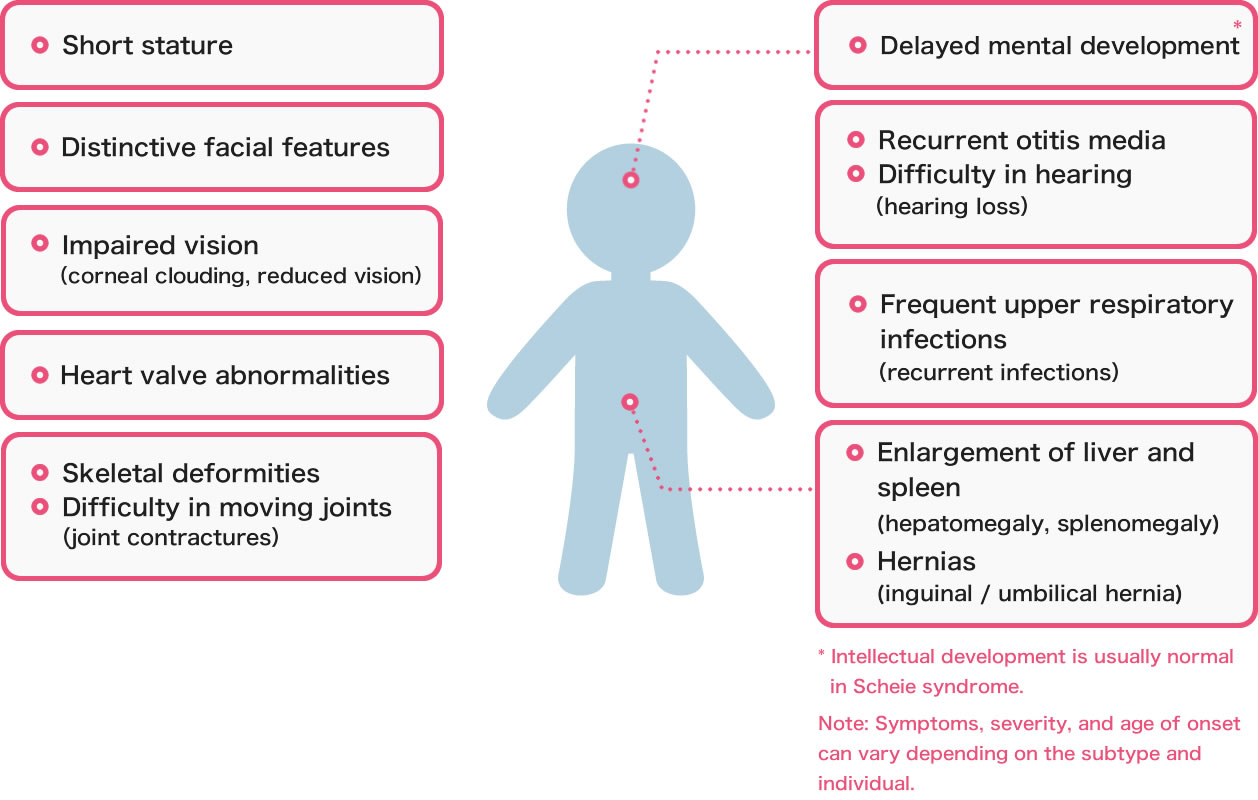
- Diagnosis
-
If characteristic symptoms suggest a high likelihood of MPS, diagnostic tests are performed to measure urinary mucopolysaccharide levels and evaluate enzyme activity in blood or cells. When necessary, additional tests such as skeletal X-rays or genetic testing are used to confirm the diagnosis.
In Japan, expanded newborn screening programs—which offer testing for conditions beyond standard newborn screening—have been expanding. Some local governments include MPS I in these screening programs. If a screening result comes back positive, the infant must undergo comprehensive diagnostic testing at a specialized medical facility.
Related Article: What is Newborn Screening? - Japanese only - Treatment
-
Treatment options include symptom management and disease-modifying therapies.
Symptom management focuses on managing individual symptoms to improve comfort, such as providing oxygen therapy for breathing difficulties or performing surgery for hernias.
Disease-modifying therapies include Enzyme Replacement Therapy (ERT) and Hematopoietic Stem Cell Transplantation (HSCT), which are selected based on the patient's subtype and health status. - Prognosis
-
When diagnosed early—such as shortly after birth—and treated promptly, patients generally have a better outlook. Choosing the appropriate treatment tailored to the specific subtype can improve both quality of life and long-term prognosis.

Editorial supervision: Kimitoshi Nakamura, MD, PhD (Professor, Department of Pediatrics,
Graduate School of Medical Sciences, Kumamoto University)
Reference materials
- Mucopolysaccharidosis type I. Information Center for Specific Pediatric Chronic Diseases, Japan (https://www.shouman.jp/disease/details/08_06_075/) (Accessed Aug 20, 2026)
- Yoshikatsu Eto, ed. Lysosomal Storage Disease - Recent Advances in Pathophysiology, Diagnosis, and Treatment - Revised 2nd Edition. SHINDAN TO CHIRYO SHA, Inc. 2023.
